
Car valuation in Switzerland: the factors that determine market value
What is my car worth? Age, mileage, equipment, condition and import status – how market value is formed in Switzerland, and how trade-in and retail value differ.
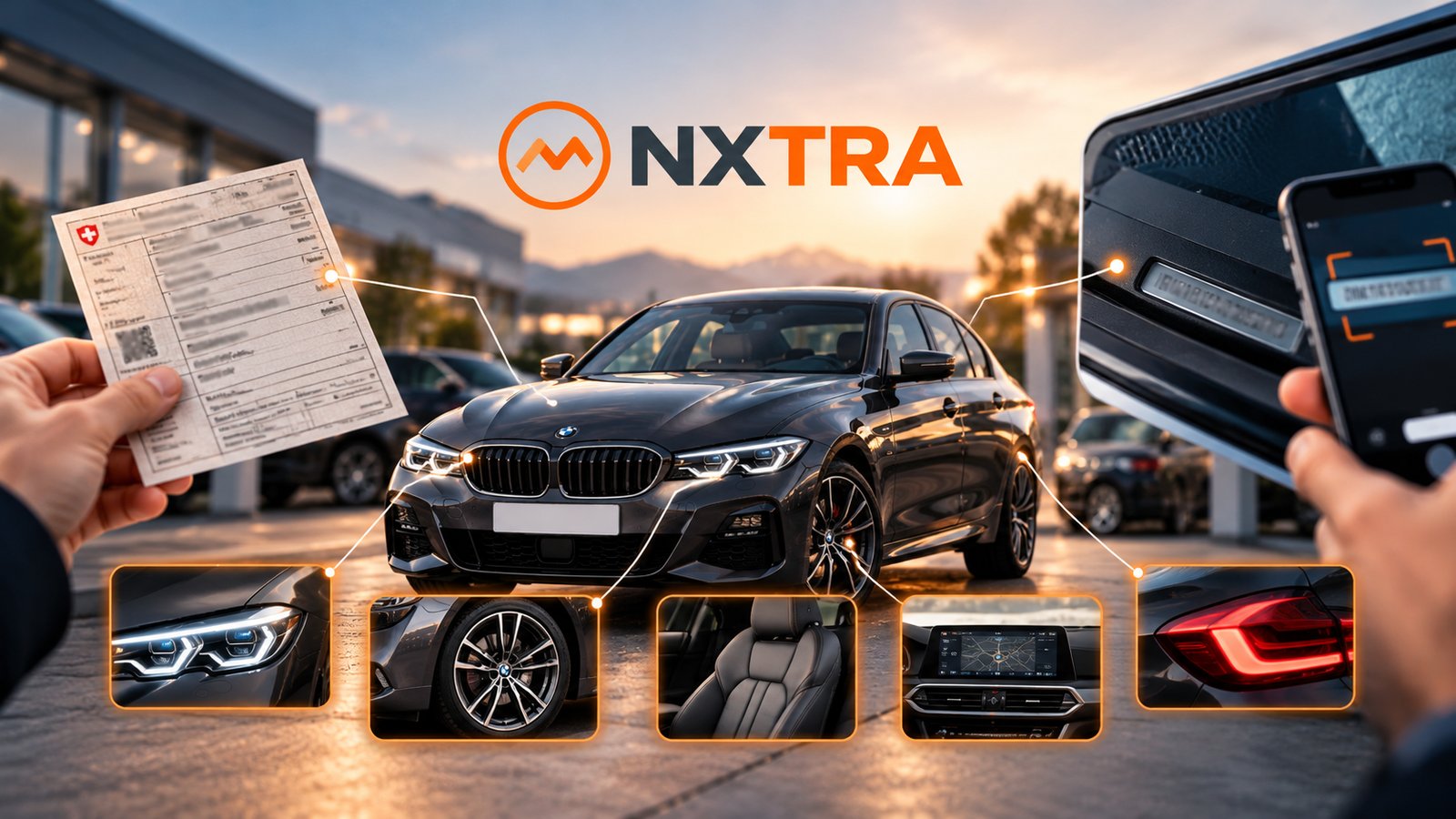
Whether you want to sell, trade in your car or buy a used one: a realistic price saves time, stress and often a lot of money. But what actually makes up a vehicle’s market value in Switzerland?
The key factors
Age and mileage
The older a car and the more kilometres, the lower its value – especially in the first few years. The ratio matters: low mileage for the age is a plus. Age is measured from the first registration (field 36 of the Swiss registration document).
Equipment – above all optional extras
Packages and options such as driver assistance, leather, a panoramic roof or a tow bar can noticeably raise the value. Many online calculators do not ask about equipment at all, or only roughly. See Finding a car’s optional equipment by VIN.
Condition and care
A well-kept car with a complete service history fetches more than a comparable one with defects, damage or missing records.
Accident history and previous owners
Repaired accident damage and many previous owners lower the price. Openness pays off: documented repairs build trust.
Import or Swiss specification
Direct and parallel imports are often valued lower than cars from the official import. See Spotting direct and parallel imports.
Inspection, season and demand
A recent Swiss vehicle inspection (MFK) makes selling easier. Supply and demand play a part too: convertibles are in demand in spring, four-wheel-drive cars before winter.
Trade-in value and retail value: two different numbers
Trade-in value: what a dealer typically pays when buying or taking a car in part exchange.
Retail value: the price at which a comparable car is offered by dealers.
The gap covers preparation, warranty, time on the forecourt and the dealer’s margin, among other things. A private sale usually lands somewhere in between.
Why a valuation should be made for Switzerland
New prices, equipment packages, taxes and demand in Switzerland differ from neighbouring countries. A converted euro value therefore quickly leads to the wrong price. Make sure the valuation uses Swiss market data in CHF, including VAT – the way cars are offered here.
Three ways to value a car
Online calculators: quick and free, but usually just a rough range based on a few inputs.
Comparing listings: shows asking prices – not the prices actually achieved.
Valuation by VIN: takes into account the equipment actually fitted, mileage, condition and import status.
The NXTRA vehicle valuation is fully adapted to the Swiss market: enter the VIN, mileage and condition and receive the trade-in and retail value in CHF by email within seconds.
How to get more for your car
Have the service book, invoices and both keys ready.
Fix small defects and clean the car thoroughly.
List the full equipment in your ad – ideally backed by an equipment report.
Start with a realistic price: asking too much means the car sits longer.
For dealers, valuation pays off directly in the purchasing process: in the NXTRA car dealer software a valuation becomes a listing with a suggested price in one click.
Updated on 26 October 2026